

The night I finally caved and ordered a fan controller, I'd been standing in the driveway since ten thirty, flashlight in one hand, vent lid in the other, trying to walk a smoker fire down from 275 to 225 without smothering it. It was the third weekend in a row I'd done this exact dance, and my back had already told me twice that crouching next to a kettle grill at eleven at night was not something I wanted to keep doing into my sixties. Renata had gone to bed an hour before and told me through the screen door that I looked ridiculous crouched over the grill in my robe. She wasn't wrong.
That was the spring that convinced me an automatic temperature controller wasn't an indulgence for guys with more money than sense, it was the tool that would let me sleep through a twelve-hour brisket instead of setting an alarm every ninety minutes. I bought the Inkbird Wi-Fi and Bluetooth BBQ Smoker Temperature Controller that week, the version with the automatic fan, and I've now run it through a full season of overnight smokes on my kettle-turned-smoker setup, from a rack of ribs for Danielle's friends in May to a fourteen-pound brisket for Owen's birthday in October.
The Quick Verdict
Holds a smoker within a few degrees of target all night without you touching a vent, but it's a real investment you should work up to, not a first purchase for someone who grills burgers on Saturdays.
Amazon Check Today's Price →Tired of setting an alarm every ninety minutes just to babysit a fire?
The Inkbird controller runs the fan for you, so the fire tends itself while you actually sleep. See today's price and current availability on Amazon.
Amazon Check Today's Price on Amazon →A Season of Overnight Smokes
I've run the controller on eleven separate cooks since May, split mostly between the 22-inch kettle set up as a low-and-slow smoker and, twice, clipped onto the mid-size pellet rig just to see if it made any difference there. It didn't, since the pellet rig already manages its own fire and the controller had nothing left to do. Cooks ranged from a four-hour rack of St. Louis ribs to a twelve-hour brisket that started at eleven at night and finished around eleven the next morning. On every long cook I used both meat probes, one buried in the thickest part of the brisket flat and one in the point, plus the ambient probe clipped to the grate so I could read chamber temperature separately from the meat itself.
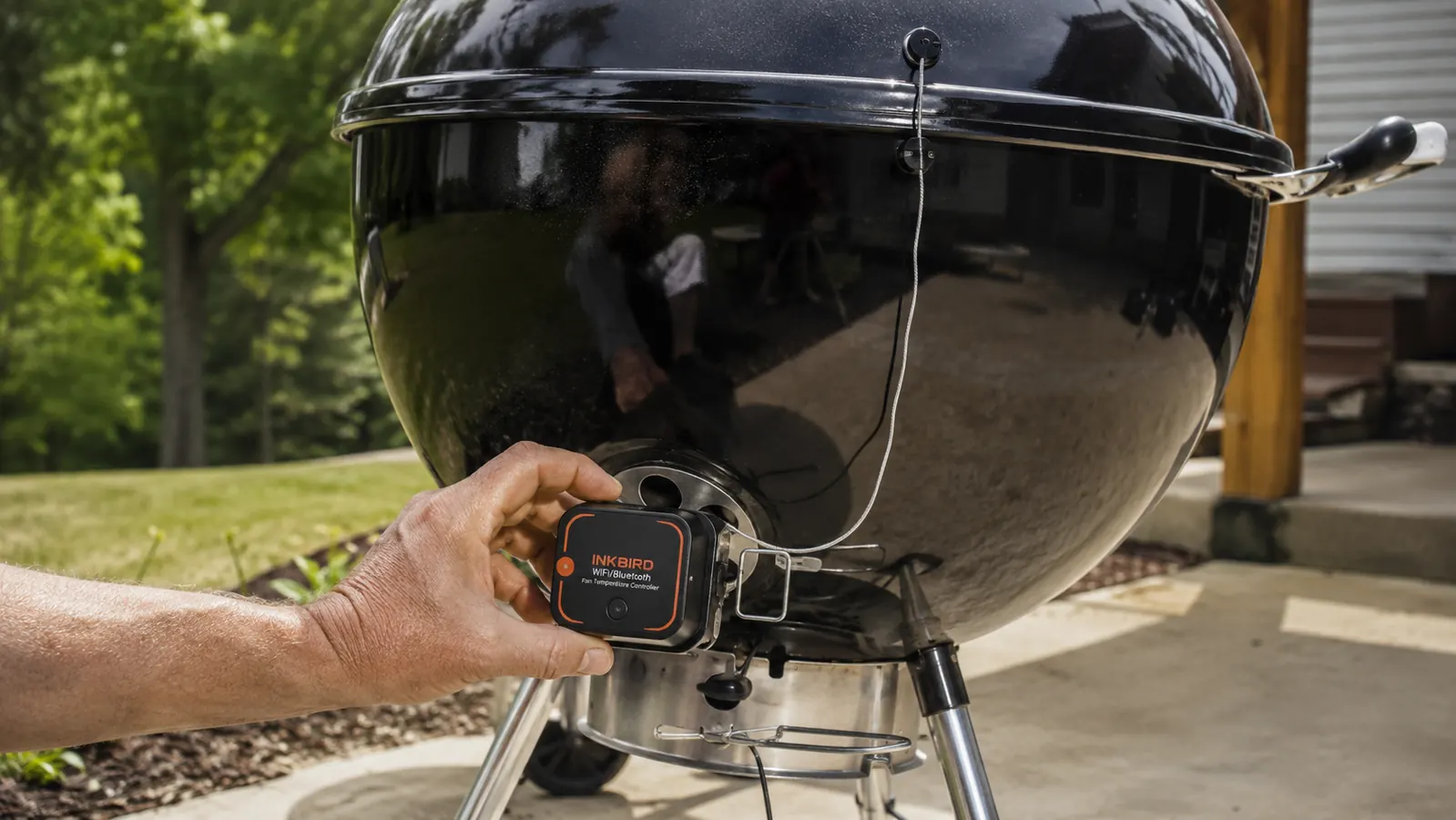
Setup takes about ten minutes the first time and closer to three once you've done it a handful of times. The fan module clamps onto the lower intake vent, the probe wires run up through a heat-resistant grommet I drilled into the kettle lid years ago for a cheaper thermometer, and the whole rig pairs to the app over Bluetooth first, then over Wi-Fi if you want to check it from inside the house, or in my case, from the recliner while a game's on.
What sold me wasn't any single cook, it was the pattern across all eleven. Every overnight smoke held within a few degrees of target without me getting out of bed once, which is not something I could say about any of the eight or nine years I spent adjusting vents by hand before this.
How the Fan and Probes Actually Work Together
The Inkbird controller reads chamber temperature off the ambient probe and compares it against the target you've set. When the chamber runs cool, the fan module kicks on and pushes air through the intake vent, which feeds the coals and pulls the temperature back up. As the chamber gets close to target, the fan throttles down, and once it's holding, the fan mostly sits idle and only pulses in short bursts to correct small drifts. It's a closed loop, and after a season of watching it work, I trust it more than I trust my own hand on a vent lid at midnight.
There are three probes total. Two are meat probes you set to alarm at a target internal temperature, useful for pulling a brisket at 203 or chicken thighs at 165 without opening the lid to check. The third is the ambient probe that drives the fan logic. All three log to the app, so I can pull up a graph after a cook and see exactly where the chamber ran hot or cold over the whole session, which has taught me more about my own kettle's habits than a decade of guessing ever did.
The app also sends push alerts. Chamber temperature swings outside your set range, you get a notification. Meat probe hits its target, you get a notification. I've gotten those alerts at two in the morning more times than I can count, glanced at the phone, seen the graph flatten back out on its own within a few minutes, and gone back to sleep without ever leaving the bed.
What Changed Once I Learned to Trust the Numbers
The first two cooks I still hovered. I'd check the app every twenty minutes, and if the fan was running longer than I expected, I'd walk out and crack a vent myself, which usually just confused the system and made the swing worse, not better. That's on me, not the controller. Old habits from years of manual vent work don't disappear just because you bought a new tool.
By August I'd stopped doing that. I set the target, I set the meat alarms, and I let it run without walking outside except to add water to the pan or check the fire visually every couple of hours out of habit more than necessity. That's when the controller actually started paying for the trust I'd put in it.
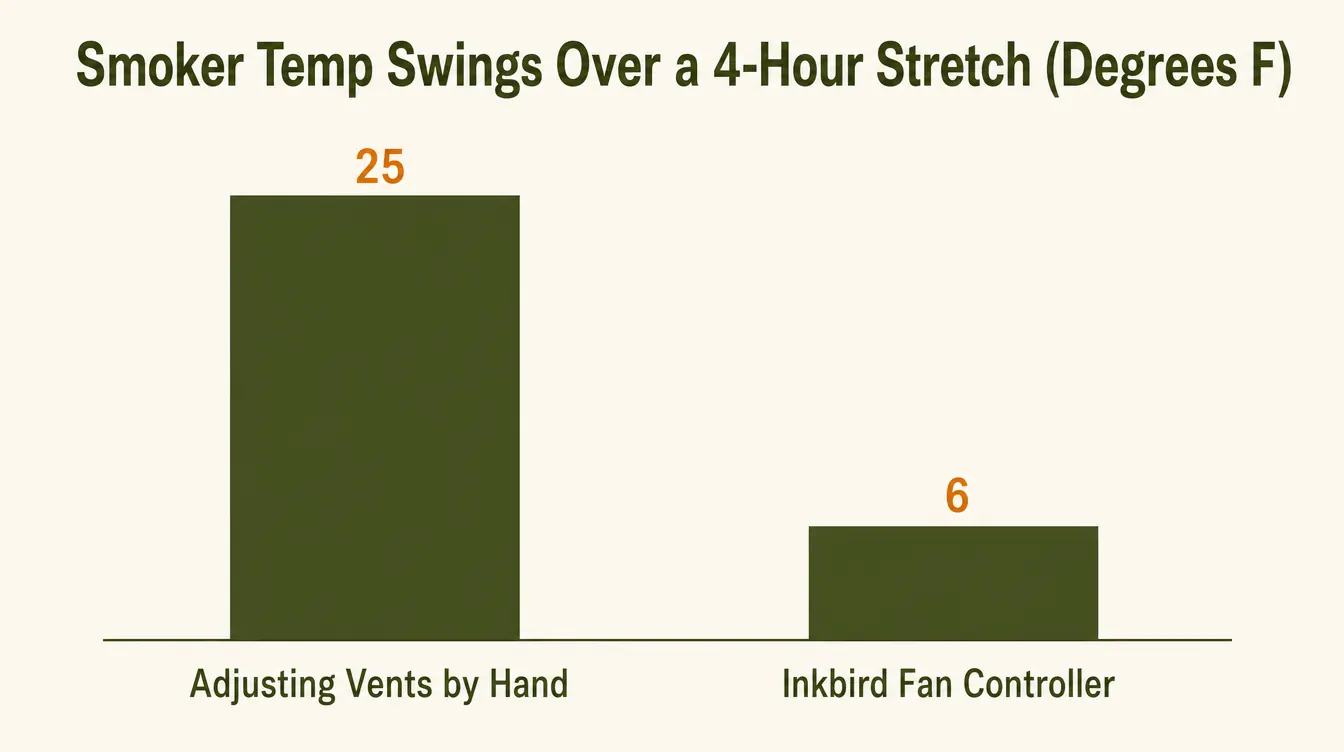
Once I quit second-guessing it, the app's graph showed the chamber holding between 222 and 228 degrees for six straight hours on a pork butt in July, a six-degree band. Compare that to the swings I used to get adjusting vents by hand, where I'd regularly see the chamber move twenty-five degrees or more over a four-hour stretch if I got busy inside and forgot to check the fire for too long. That gap is the entire reason I bought this thing.
The Money Question: Is a Fan Controller Worth Buying
I need to be straight about this part. The Inkbird controller is the most expensive tool I've reviewed on this site by a wide margin, and I'm not going to pretend that's a small thing. If you grill burgers and hot dogs on a weeknight, or you cook a couple racks of ribs a season and don't mind standing near the grill anyway, you do not need this. Save your money. A cheap dual-probe thermometer and a habit of checking the fire every half hour will serve you fine.
Where it earns its keep is overnight, low-and-slow cooks, and specifically cooking for a crowd on a schedule you don't control. A brisket for a church potluck that needs to be resting by ten in the morning means you're either starting it at ten the night before and staying awake to babysit it, or you're trusting a controller to hold the fire while you sleep. I didn't buy this for a random Tuesday rack of ribs. I bought it because I was tired of losing sleep before every big weekend cook.
I also didn't buy it on a whim. I thought about it for the better part of a season before I ordered one, watched what it cost, and decided the sleep and the consistency were worth working up to it as a deliberate purchase rather than an impulse buy. If you cook overnight two or three times a month, the math starts to make more sense than it does for someone who fires up the grill on a Saturday afternoon and calls it a day. Reading through the reasons a fan controller fixes temperature swings before I bought mine helped me decide it wasn't just a gadget, it was solving a problem I actually had.
Alternatives I Considered Before Buying
Before I settled on this one, I looked at a cheaper single-probe controller with no Wi-Fi, just a dial and a fan, sold for noticeably less. It would have handled the basic job of holding temperature, but it had no app, no meat probe alarms, and no history graph, which meant I'd still be walking out to the kettle every couple of hours just to check the meat instead of the fire. I decided the extra probes and the remote alerts were worth paying more for, since babysitting the meat temperature was half of what kept me up at night in the first place.
I also considered just retiring the kettle for overnight cooks and running everything on the pellet rig instead, since it already manages its own fire without any add-on. I didn't, because bark and smoke flavor off the kettle on a long charcoal cook still beats what I get off the pellet rig, and I wasn't willing to give that up just to avoid buying a controller.
A guy at church mentioned running a cheaper off-brand fan controller for one season and having the app lose connection constantly, to the point he went back to setting alarms by hand. That, more than anything, pushed me toward Inkbird specifically over a knockoff. It has a longer track record and a lot more reviews behind it, and after everything I put it through this season, I understand why.

Where It Let Me Down
The Wi-Fi dropped once during a big cook, an eight-hour pork butt in June, and I got no alerts for close to forty minutes while I was inside watching television. Bluetooth range from the recliner is short enough that I lean on Wi-Fi most of the time, and when the router hiccupped, the app just went quiet instead of warning me the connection was gone. I walked out to check manually and found the fire had held fine on its own, but I would have liked a clearer signal that the connection had dropped rather than finding out by accident.
The fan clip that comes with it didn't sit snug on my particular kettle's vent, which has a slightly different lip than the standard kettle it's clearly designed around. I ended up borrowing a hose clamp out of Gil's garage, which he still hasn't asked for back, to hold the fan module tight against the vent so it wouldn't rattle loose mid-cook. It's a five-minute fix, but it shouldn't have been necessary on a tool at this price.
The app itself has more menus than I needed for what I actually do with it, alarm profiles, cook history, multiple device pairing for people running more than one grill. I only use a fraction of it, and it took a couple of cooks before I stopped fumbling through screens looking for the one setting I wanted.
One of the probe wires has started to fray a little near the connector after a season of being coiled up and thrown in the same tote as my grill tools. It still reads accurate, but I've started wrapping it separately in a small bag so it doesn't get pinched between the tote lid and my chimney starter, which is more babying than I'd like to do with a probe on a tool that cost this much to begin with.
What I Liked
- Held chamber temperature within a few degrees of target on every overnight cook this season
- Two meat probes plus one ambient probe cover a full brisket without opening the lid
- App alerts let you sleep through the night instead of checking every ninety minutes
- Works on a charcoal kettle just as well as it would on other charcoal or wood setups
Where It Falls Short
- The most expensive tool I've reviewed on this site, not a casual purchase
- Wi-Fi dropped once with no clear warning that the connection was lost
- Fan clip didn't fit my kettle's vent lip snugly out of the box
- App has more menus and settings than most home cooks will ever touch
I used to set an alarm every ninety minutes to babysit the fire. Now the fire babysits itself, and I actually sleep.
Who This Is For
This is for the person who already cooks overnight low-and-slow more than a couple times a month, who feeds a crowd on a schedule that doesn't bend, church potlucks, family gatherings, a driveway full of people expecting brisket by noon. If losing sleep before a big cook has become a real cost to you, this tool trades money for that sleep, and after a full season I think it's a fair trade.
Who Should Skip It
If your grilling is mostly weeknight burgers, weekend chicken thighs, or the occasional rack of ribs where you're already standing near the grill anyway, skip this and put the money toward better meat instead. A fan controller solves a specific problem, staying awake for hours to babysit a fire, and if that isn't your problem, you're paying for a solution you don't need.
Ready to actually sleep through your next overnight brisket?
See today's price and current stock on the Inkbird Wi-Fi and Bluetooth BBQ Smoker Temperature Controller on Amazon before your next big cook.
Amazon Check Today's Price on Amazon →