
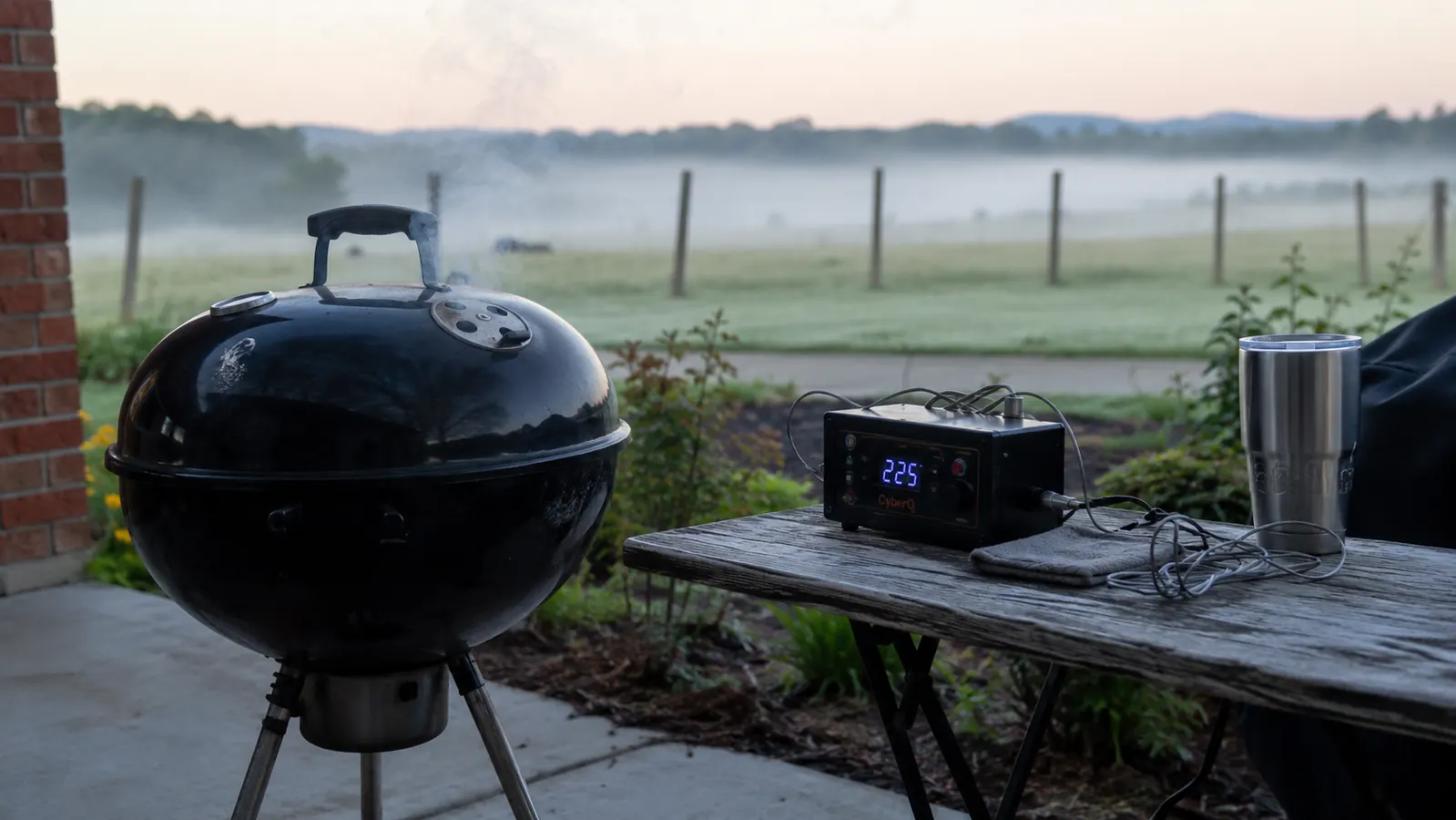
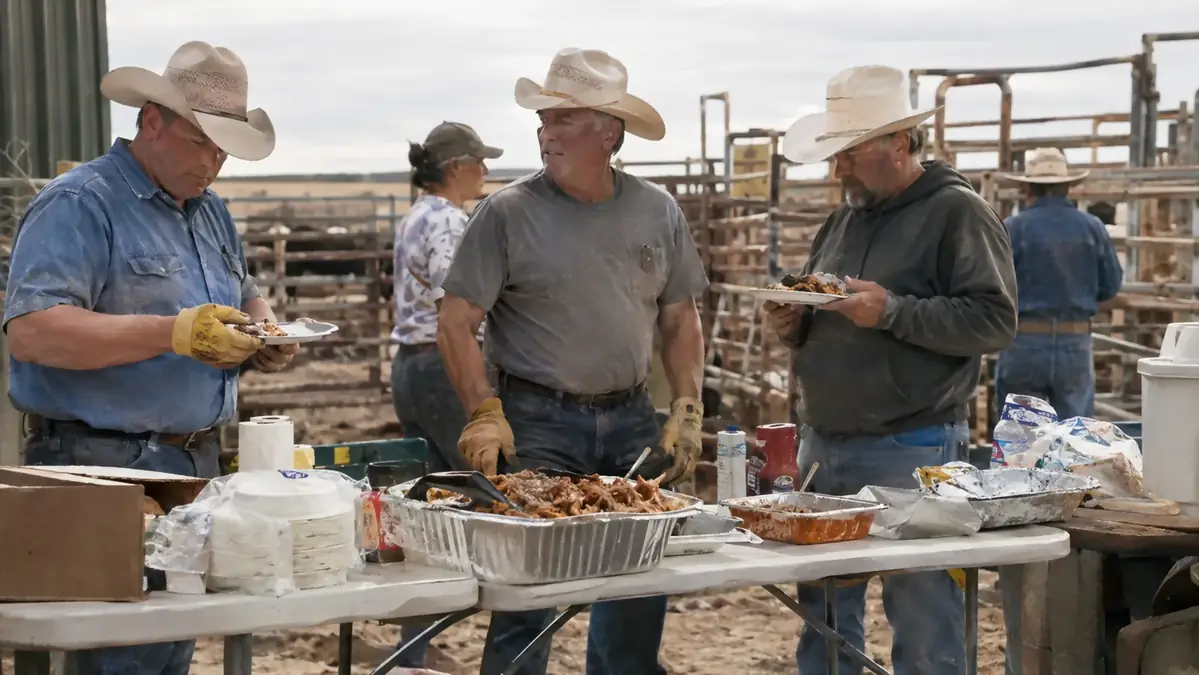
I brought the Inkbird controller out to my brother Wade's place for his cattle-branding day last spring, the first time I'd run it anywhere other than my own driveway, and it taught me more about the thing's real limits than a whole stretch of easy cooks at home ever did. Wade runs cattle on land about twenty minutes past mine, and every spring the extended family and half the neighbors show up before sunup to work calves, which means somebody has to feed thirty hungry people by early afternoon whether the branding runs on schedule or not. I loaded two pork shoulders into the kettle before four that morning, clipped the controller onto the vent, and figured I could walk off and help with the branding while it held the fire on its own. Mostly, it did.
I want to be straight with you before you spend real money on this thing, because it's the most expensive item I've put on this site and there's a chunk of buyer's remorse baked into that price whether the tool works or not. I resisted buying an Inkbird controller for the better part of two years, watched it get added to the household wish list and taken off again more than once, and only pulled the trigger once I'd talked myself into believing I actually had the kind of cooking schedule that justified it. Some of what I found after buying it lines up with what you'd expect from the marketing photos. Some of it doesn't, and that second part is what nobody selling you this thing bothers to mention.
The Quick Verdict
It genuinely holds a fire steady when you walk away from it, but the fan noise, the app's rough edges, and the price mean most backyard cooks should think twice before buying one.
Amazon Check Today's Price →Before you spend the most money you'll spend on any smoker accessory, know exactly what you're getting.
This one isn't cheap, and it isn't for everybody. See today's price and decide for yourself whether it fits how often you actually cook overnight.
Amazon Check Today's Price on Amazon →How I've Actually Used It
I've run this controller eight or nine times since I bought it, not every single weekend the way you might picture from the marketing photos of guys grinning next to their phones like they've never worried about a fire again in their life. Wade's cattle-branding day was the biggest test, the farthest I'd ever pushed it. Past that, it's been a rainy Sunday pork shoulder where I didn't want to stand outside under an umbrella checking vents every twenty minutes, a rack of ribs on the Fourth of July while I was busy setting up folding chairs and hauling coolers for company, and once I lent the whole rig to Gil for a chili cook-off two counties over, mostly because he asked and I didn't have anything on the calendar that weekend anyway.
Danielle was skeptical the first time she watched me set it up at her place for a get-together, asking why a grown man needed an app on his phone to do a job a vent lid does for free. I didn't have a great answer for her that day, honestly, because the cook we were doing was short enough that hand-adjusting the vent would have worked just as well. The Inkbird earns its keep on the long, unattended stretches, the ones where you genuinely need to walk away for hours, not the two-hour cooks where you're standing around the yard anyway with a drink in your hand.
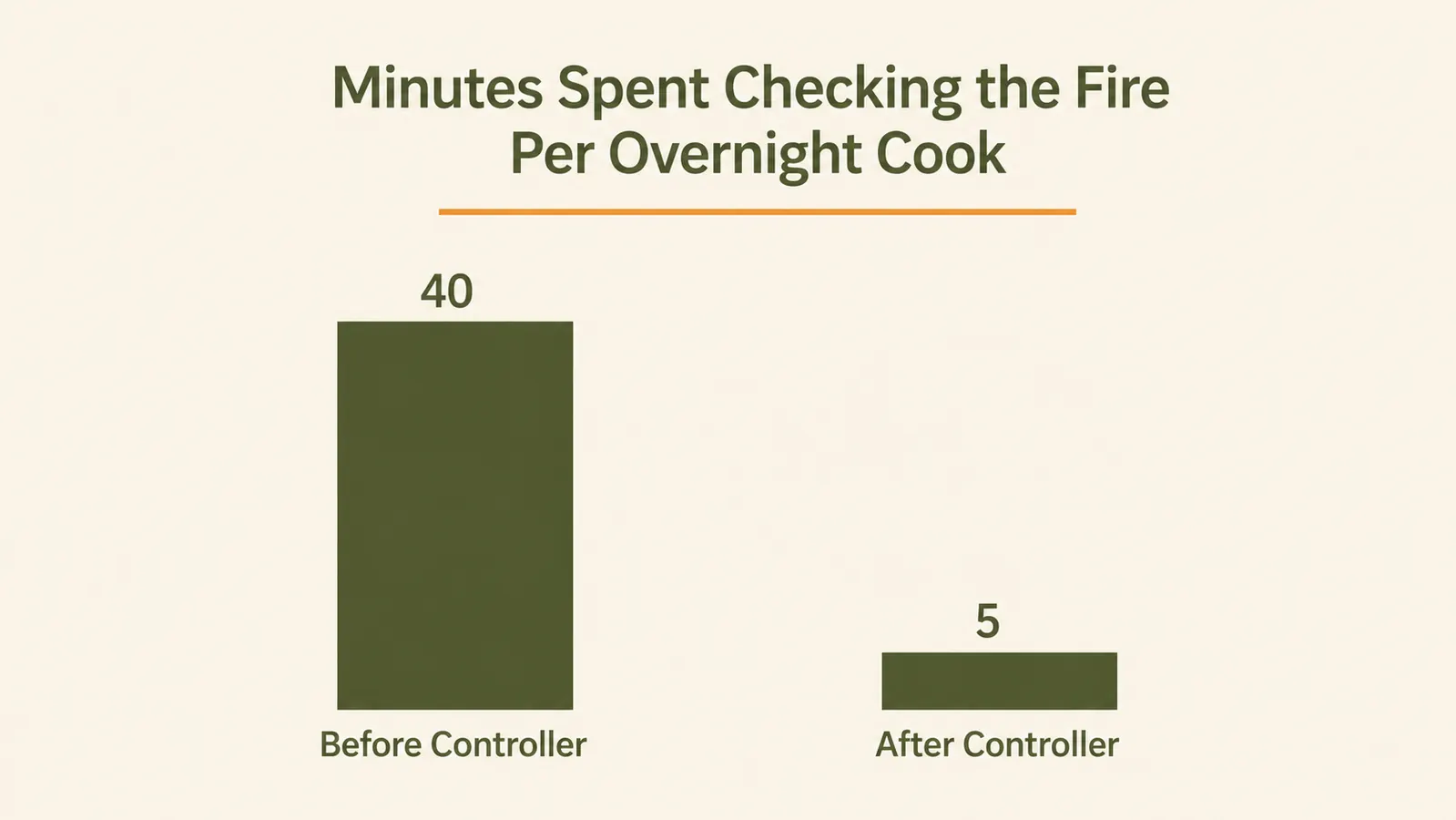
I used to walk out to the grill every fifteen or twenty minutes through a long overnight cook, which by my rough count added up to something like forty minutes of standing there over the course of a night, between checking the fire, checking the meat, and just not trusting the thing to hold on its own without me watching it. With the controller running, that drops to something closer to five minutes total, mostly glancing at the app on the nightstand and occasionally walking out to check the ash pan before I go back to bed. That gap is real, and it's the whole reason I eventually bought one after all that hemming and hawing.
What Nobody Tells You About the Fan Noise
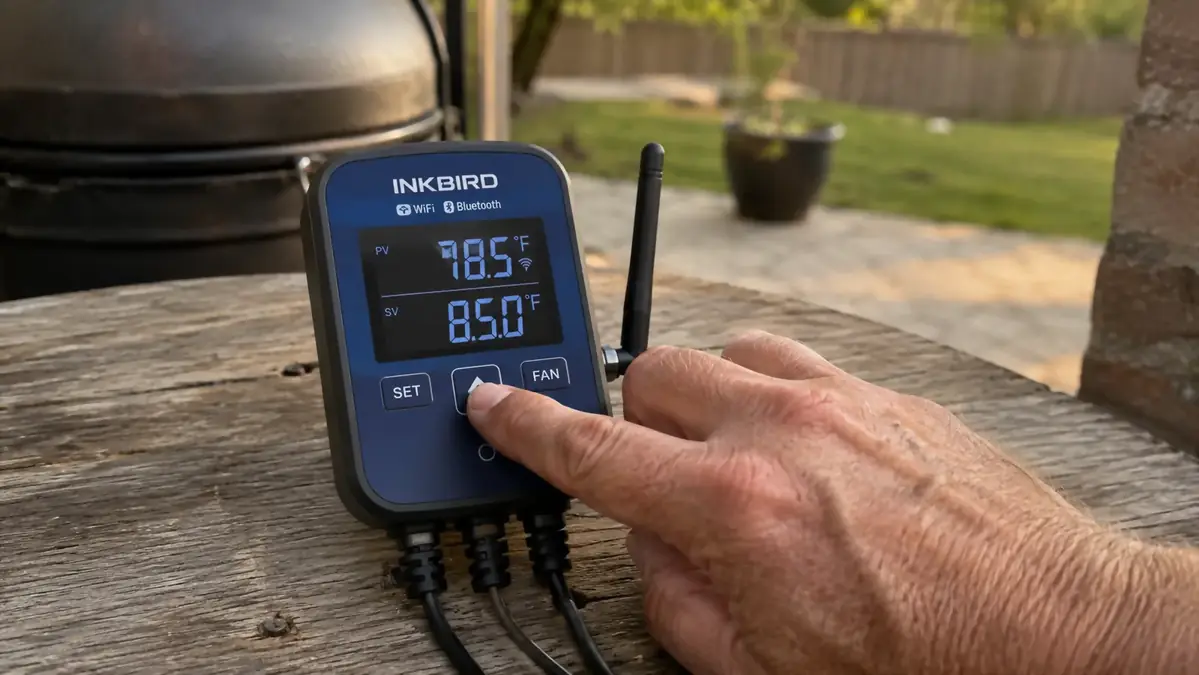
The fan has a whine to it that you don't hear in any of the product videos, probably because those are filmed in daylight with music playing over the top of everything. At two in the morning with the neighborhood dead quiet, it's noticeable enough that Renata mentioned it the first two nights I ran an overnight cook, a low mechanical hum coming through the bedroom window that she said sounded like somebody left a bathroom fan running out in the yard. It never bothered me enough to lose sleep over it myself, but I'll admit I hadn't expected to notice it at all, and nothing I read before buying one mentioned it.
When Gil borrowed the Inkbird for his chili cook-off, he called me the next week to say his dog wouldn't settle down the whole night it ran in his backyard, pacing by the fence every time the fan cycled on to correct the temperature. I don't know if that's typical or if Gil's dog is just high-strung by nature, but it's the kind of small detail that never comes up in a five-star review written after one good weekend cook. If you've got close neighbors, thin bedroom walls, or a light sleeper in the house, it's worth knowing before you set one up for the first time and hope for the best.
The App Has a Learning Curve the Box Doesn't Mention
Getting the controller paired the first time meant creating an account, granting the app a handful of phone permissions I wasn't thrilled about signing away, and re-entering the home Wi-Fi password twice because the first attempt silently failed with no error message telling me what had actually gone wrong. None of that is disqualifying on its own, but it's a fifteen-minute chore that the box makes sound like a thirty-second tap and forget about it. If you're the kind of guy who still texts with two thumbs and one eye closed, budget more patience for the setup than the packaging leads you to expect.
The notification settings tripped me up worse than the pairing did. I got a low-battery alert on one of the meat probes at one in the morning during the rainy Sunday cook, jolting me wide awake for what turned out to be nothing, since the probe kept reading accurately for another six hours after the warning fired for the first time. I've since turned that particular alert down in the settings, but finding the right screen to do it took me longer than I want to admit, buried two menus deep under a label that didn't say what I expected it to say at all.
The Morning I Trusted It Too Much
Here's the part I haven't seen anybody else write about. At Wade's branding day, I set the controller and walked off to help pin calves for close to two hours, farther from the kettle than I'd ever left it before and busier than I'd normally let myself get during a cook. When I finally checked the app, the chamber had crept more than forty degrees above target and stayed there for the better part of an hour before I even noticed, the alert buried under a stack of other notifications on a phone I hadn't looked at since sunrise.
The ash pan had built up enough to partially block airflow near the fan's intake, which meant the fan was running flat out and still couldn't hold the chamber down where I'd set it. The bark on one shoulder came out darker than I wanted, edges drier than they should have been, and I had to trim more than I'm used to before pulling it apart in front of thirty hungry people. Nobody at the branding day seemed to mind or even noticed, but I knew the difference, and it was a fair reminder that the Inkbird manages the fan, not the ash pan. That part is still on you, no matter how far away you wander or how much you trust the app.
What It Got Right When It Mattered
I don't want the ash pan story to drown out the rest of it, because on the cooks where I actually paid attention, the controller did exactly what I bought it to do. The rainy Sunday shoulder held within a handful of degrees of target for nearly ten hours while I stayed dry inside, checking the app from the couch instead of standing under an umbrella arguing with a vent lid the way I would have a few years back. Gil's chili cook-off went fine too, by his account, once his dog got used to the noise partway through the night.
The Fourth of July ribs were the easiest proof of concept, honestly, because I had every excuse to forget about the grill entirely with company in the yard and kids running around underfoot. I checked the app twice the whole afternoon, both times just to confirm the meat probe was climbing the way it should, and pulled a rack that was as good as anything I've made standing over the fire myself. When the conditions are right, an Inkbird controller lets you actually enjoy the parts of a cookout that aren't the fire, and that's worth something even after everything above.
Where the Price Actually Gets You
I need to say this plainly. The Inkbird is the priciest single item I've reviewed on this site, by a wide margin, and today's price is not a small ask for something that, at its core, is a fan and two probes wired to an app. I don't regret buying mine, but I also didn't buy it on a whim, and I'd push back hard on anyone telling you it's a no-brainer purchase for a casual backyard cook. Reading through the reasons a fan controller earns its keep before you buy is a better use of fifteen minutes than watching another glowing unboxing video promising you'll never think about your fire again.
Where it pencils out is if you're already cooking overnight two or three times a month, feeding a crowd on a schedule that doesn't bend, and losing real sleep over it the way I was before I bought mine. If that's not your situation, the money is probably better spent on a cheaper dual-probe thermometer and getting comfortable adjusting vents by hand, which costs a fraction as much and does the job just fine for anyone who isn't cooking overnight on a regular basis to begin with.
What I Liked
- Held the fire steady enough at Wade's branding day and on a rainy cook that I could genuinely walk away
- Cut the amount of time I spent physically standing at the grill during a long cook by a wide margin
- Two meat probes plus the ambient probe cover a full cook without opening the lid to check
- Worked fine after being lent out to Gil for a cook-off two counties away, no compatibility issues
Where It Falls Short
- Fan has an audible whine at night that both my wife and Gil's dog noticed
- Ash buildup near the intake caused a real overshoot during the one cook I left it alone the longest
- App setup and notification settings took longer to sort out than the box implies
- The most expensive tool I've reviewed on this site by a wide margin, not a casual buy
It isn't magic. It's a fan on a timer that still needs you to check the ash pan just as much as you'd think.
Who This Is For
This makes sense for somebody already cooking overnight on a real schedule, feeding a crowd, a branding day, a cook-off, a family gathering where the food has to be ready at a set hour and losing sleep over it has become a genuine cost to you. It also makes more sense if you're willing to learn an app with a few rough edges and still check on the fire once in a while instead of treating it as fully hands-off the way I made the mistake of doing at Wade's place.
Who Should Skip It
If you're cooking burgers on a Tuesday, a couple racks of ribs a season, or anything short enough that you're standing near the grill anyway, skip this one and save the money for better meat instead. Same goes if you've got close neighbors, thin walls, or a dog that startles at low mechanical noise through the night. The Inkbird solves a specific, expensive problem, and if losing sleep over an overnight fire isn't actually your problem, you're paying full price to fix something that was never broken for you in the first place.
Still think it's worth it after everything above?
For the right cook, it earns its keep. Read the full <a href="/inkbird-temperature-controller-review-long-term">season-long breakdown</a> and see today's price on the Inkbird Wi-Fi and Bluetooth BBQ Smoker Temperature Controller before your next overnight cook.
Amazon Check Today's Price on Amazon →